
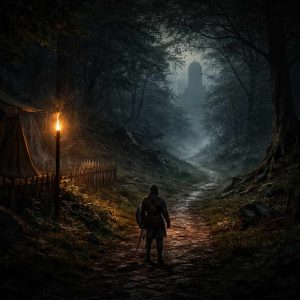
 When people talk about Diablo II, they often focus on loot, builds, monsters, and iconic D2 items. But one of its most effective design tools is quieter. The game uses the environment to guide players through the world without relying on constant instructions. Long before quest markers became standard, Diablo II taught players where to go, what to fear, and when to prepare through visual and spatial cues alone. This approach gives the adventure a natural flow. Players feel like they are exploring rather than being led. The world nudges them forward, step by step, through terrain, lighting, and layout rather than dialogue boxes.
Clear Paths in a Hostile World
From the opening moments near the Rogue Encampment, the game establishes a clear relationship between safety and danger. Towns are open, well-lit, and orderly. Paths are wide. Movement feels relaxed. The moment players step outside, the environment changes. Trees close in. Paths narrow. Visibility drops.
These contrasts matter. Roads subtly point toward objectives. Forks appear at moments where exploration makes sense. Dead ends often hide optional content, not main objectives. Even without a map, players learn to read the land. A worn trail through the wilderness feels intentional. A broken fence or collapsed wall invites curiosity.
Diablo II rarely blocks progress with invisible walls. Instead, it uses natural barriers like rivers, cliffs, and dense foliage. Players instinctively follow openings and slopes. The environment teaches navigation through logic rather than rules.
Vertical Descent and Rising Threat
One of the game’s most effective environmental tools is vertical movement. Many key locations involve descending deeper into danger. Cellars, crypts, sewers, and catacombs all reinforce a simple idea: down is worse than up.
As players descend, ceilings lower and rooms tighten. Light sources become sparse. Sound design shifts. Monsters grow more aggressive. Without a single warning, the game signals that preparation matters. Potions, repairs, and caution become habits learned through space rather than failure messages.
Boss encounters almost always sit at the deepest point of an area. The long descent builds tension naturally. Players feel the weight of commitment. Turning back means retracing dangerous ground. Pushing forward feels risky but necessary.
Visual Identity as Direction
Each act has a distinct visual identity, and that identity does practical work. Act I’s forests are damp and muted, with ruined stone structures hinting at fallen civilizations. Act II opens into harsh desert spaces with long sightlines and blinding light. Act III traps players in dense jungles where paths twist, and visibility shrinks. Act IV strips the world down to hellish stone and fire, removing comfort entirely.
These shifts are not just aesthetic. They reset player expectations. Wide desert spaces suggest ambush from afar. Jungles suggest close-quarters danger. Hell itself offers no safe edges, signaling that the endgame allows no retreat.
Players subconsciously adapt their movement and combat style based on the environment. The world teaches them how to survive within it.
Landmarks That Anchor Progress
Diablo II relies heavily on landmarks. Windmills, towers, temples, and fortress walls appear on the horizon long before players reach them. These structures act as visual promises. They say, “This matters.”
Even randomized maps respect this logic. While layouts change, major landmarks remain readable. A tower rising above the trees signals significance. A fortress gate framed by broken ground draws the eye forward. Players always have a sense of direction, even when the exact path shifts.
This balance between randomness and clarity is critical. The world feels unpredictable, but never confusing. Players stay oriented because the environment keeps offering reference points.
Environmental Storytelling Without Exposition
Much of Diablo II’s story is told through space rather than dialogue. Blood-stained altars, abandoned camps, and corrupted temples tell the story without words. The further players travel, the more broken the world becomes.
Enemy placement reinforces this storytelling. Fallen enemies cluster near ruined villages. Demons occupy former places of worship. By the time players reach the depths of Hell, the environment has already explained the stakes.
This approach keeps momentum intact. Players learn by moving, not stopping to read. The environment respects their time and attention.
Teaching Through Repetition and Variation
The game introduces environmental ideas early, then repeats them with variation. Narrow corridors first appear in safe contexts, then later in deadly ones. Open spaces initially feel freeing, then become arenas for overwhelming enemies.
Because these lessons are learned gradually, players rarely feel surprised by unfairness. When danger spikes, the environment has already warned them. Tight spaces mean crowd control matters. Open ground means positioning is key.
The world trains the player through experience, not instruction.
Why It Still Works
Many modern games rely on explicit guidance. Icons, arrows, and glowing paths dominate the screen. Diablo II proves those tools are optional. By trusting players to read the environment, it creates a stronger sense of agency.
Players don’t just complete objectives. They understand where they are and why it matters. The world feels coherent, dangerous, and alive.
That is why the adventure still holds up. Diablo II does not tell players where to go. It shows them. And by doing so, it turns simple movement into meaningful exploration.